Het begrijpen van accucapaciteit en laadsnelheid is essentieel om EV-specificaties te begrijpen. Deze twee factoren bepalen hoe ver je kunt rijden en hoe snel je kunt opladen.
Accucapaciteit (kWh)
Wat is kWh?
kWh (kilowattuur) is de eenheid die wordt gebruikt om accucapaciteit te meten - in wezen de "grootte van de tank". Eén kWh is de hoeveelheid energie die wordt verbruikt door een apparaat van 1.000 watt dat één uur draait.
Denk erover als liters in een brandstoftank: een grotere accu (meer kWh) slaat meer energie op en biedt een langere actieradius, net zoals een grotere brandstoftank meer brandstof bevat.
Kleine Accu's (40-60 kWh)
Range: Actieradius: 240-400 km
Examples: Nissan Leaf, Mini Cooper SE, Mazda MX-30
Best for: Stadsritjes, kort woon-werkverkeer, tweede auto's
Advantages: Lagere kosten, sneller opladen (kleinere accu = minder te laden)
Middelgrote Accu's (60-80 kWh)
Range: Actieradius: 400-560 km
Examples: Tesla Model 3/Y Standard Range, Chevrolet Bolt, VW ID.4
Best for: Dagelijks rijden met incidentele roadtrips
Advantages: Goede balans tussen actieradius, kosten en laadtijd
Grote Accu's (80-100+ kWh)
Range: Actieradius: 480-640+ km
Examples: Tesla Model S/X, Ford F-150 Lightning Extended Range, BMW iX
Best for: Frequent lange afstanden reizen, trekken, maximale flexibiliteit
Advantages: Maximale actieradius, minder vaak opladen nodig
Bruikbare vs. Totale Capaciteit
Important: De totale accucapaciteit is niet hetzelfde als de bruikbare capaciteit. Fabrikanten bouwen bufferzones in om de gezondheid van de accu te beschermen.
Example: Een accu geadverteerd als 75 kWh kan hebben:
- Totale capaciteit: 77 kWh (werkelijke fysieke capaciteit)
- Bruikbare capaciteit: 75 kWh (wat je daadwerkelijk kunt gebruiken)
- Buffer: 2 kWh gereserveerd om de accu te beschermen tegen schade
Deze buffer voorkomt dat de accu volledig leegraakt (wat lithium-ionbatterijen beschadigt) en verlengt de algehele levensduur van de accu.
Laadsnelheid (kW)
Wat is kW?
kW (kilowatt) meet de snelheid van energieoverdracht - hoe snel energie in de accu stroomt. Hoger kW = sneller laden.
Denk erover als waterstroom: kWh is de grootte van de emmer, kW is hoe breed de slang is. Een bredere slang (hoger kW) vult de emmer sneller.
Niveau 1 (1.4-1.9 kW)
Standaard 120V/230V stopcontact
Example: 60 kWh accu
- • ~5-8 km/u toegevoegd
- • 30-40 uur voor volledige lading
- • Alleen voor noodgevallen/overnachting
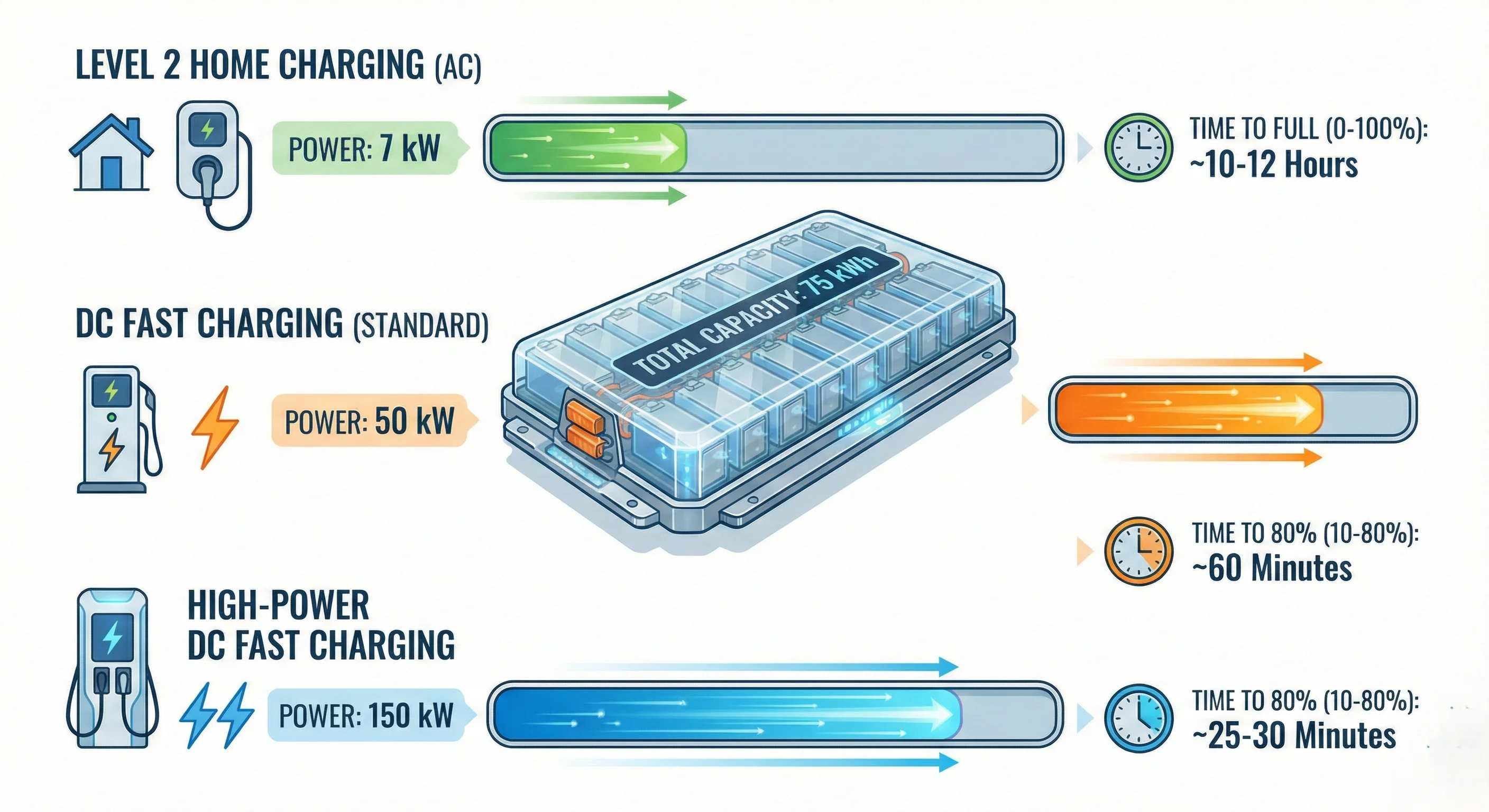
Niveau 2 (7-11 kW)
240V/400V thuis/openbare lader
Example: 60 kWh accu
- • ~40-65 km/u toegevoegd
- • 6-8 uur voor volledige lading
- • Ideaal voor dagelijks laden
DC Snelladen (50-350 kW)
Openbare snelladers
Example: 60 kWh accu
- • ~240-1600 km/u toegevoegd
- • 20-40 min tot 80%
- • Roadtrips & snelle stops
Laadtijd Berekenen
De Basisformule
Laadtijd = Accucapaciteit ÷ Laadvermogen
Tijd (uren) = kWh ÷ kW
Voorbeeld 1: Thuis Laden
75 kWh accu, 7,2 kW lader, laden van 20% naar 80%
• Energie nodig: 75 kWh × 60% = 45 kWh
• Tijd: 45 kWh ÷ 7,2 kW = 6,25 uur
Voorbeeld 2: DC Snelladen
75 kWh accu, 150 kW lader, laden van 10% naar 80%
• Energie nodig: 75 kWh × 70% = 52,5 kWh
• Tijd (indien constant): 52,5 kWh ÷ 150 kW = 0,35 uur = ~21 minuten
*Opmerking: Werkelijke tijd kan langer zijn door laadcurve
Reality Check: Deze formule geeft je het theoretische minimum. In de praktijk wordt laden beïnvloed door temperatuur, laadstatus van de accu, delen van laders en de laadcurve (snelheid neemt af naarmate de accu voller raakt).
Wat Beperkt de Laadsnelheid?
Voertuigbeperkingen
- • Max AC laadsnelheid: Beperkt door boordlader (typisch 7-11 kW)
- • Max DC laadsnelheid: Voertuigspecifiek (50-250+ kW)
- • Accutemperatuur: Koude accu's laden langzamer
- • Laadstatus (SoC): Vertraagt aanzienlijk na 80%
Externe Beperkingen
- • Ladervermogen: Kan de max output van de lader niet overschrijden
- • Gedeelde circuits: Stroom verdeeld over meerdere auto's
- • Netcapaciteit: Lokale elektrische infrastructuurbeperkingen
- • Kabelclassificatie: Kabel moet het stroomniveau ondersteunen
Key Point: Je laadsnelheid wordt altijd beperkt door de laagste waarde. Een 350 kW lader zal een auto met een max snelheid van 50 kW niet sneller laden dan een 50 kW lader zou doen.
Efficiëntie: Mijl per kWh
Net als MPG voor benzineauto's, hebben EV's een efficiëntieclassificatie gemeten in mijl per kWh (of kWh per 100 mijl). Dit vertelt je hoe ver je kunt rijden op elke kWh energie.
Efficiënte EV's
4-5 mi/kWh (6,4-8 km/kWh)
Compacte auto's, sedans
Example: Tesla Model 3, Hyundai Ioniq 6
Gemiddelde EV's
2,5-3,5 mi/kWh (4-5,6 km/kWh)
SUV's, crossovers
Example: Ford Mustang Mach-E, VW ID.4
Minder Efficiënt
1,5-2,5 mi/kWh (2,4-4 km/kWh)
Grote SUV's, pick-ups
Example: Rivian R1T, GMC Hummer EV
Actieradius Berekenen
Formule: Actieradius = Accucapaciteit × Efficiëntie
Voorbeeld: 75 kWh accu × 3 mi/kWh = 225 mijl actieradius
*Actieradius in de praktijk varieert met rijstijl, weer, terrein en snelheid
Snelle Referentie
kWh (Accucapaciteit): Grootte van de "tank" - bepaalt totale actieradius
kW (Laadvermogen): Snelheid van laden - bepaalt hoe snel je bijvult
mi/kWh (Efficiëntie): Hoe ver je komt per energie-eenheid - zoals MPG
Laadtijd: Accucapaciteit ÷ Laadvermogen (met variaties in de praktijk)
Sweet Spot: 60-80 kWh accu met 7-11 kW thuisladen voor de meeste bestuurders