Understanding EV charging can seem complicated at first, but it's actually quite straightforward once you learn the basics. There are three main charging levels and several connector types used across different regions and manufacturers.
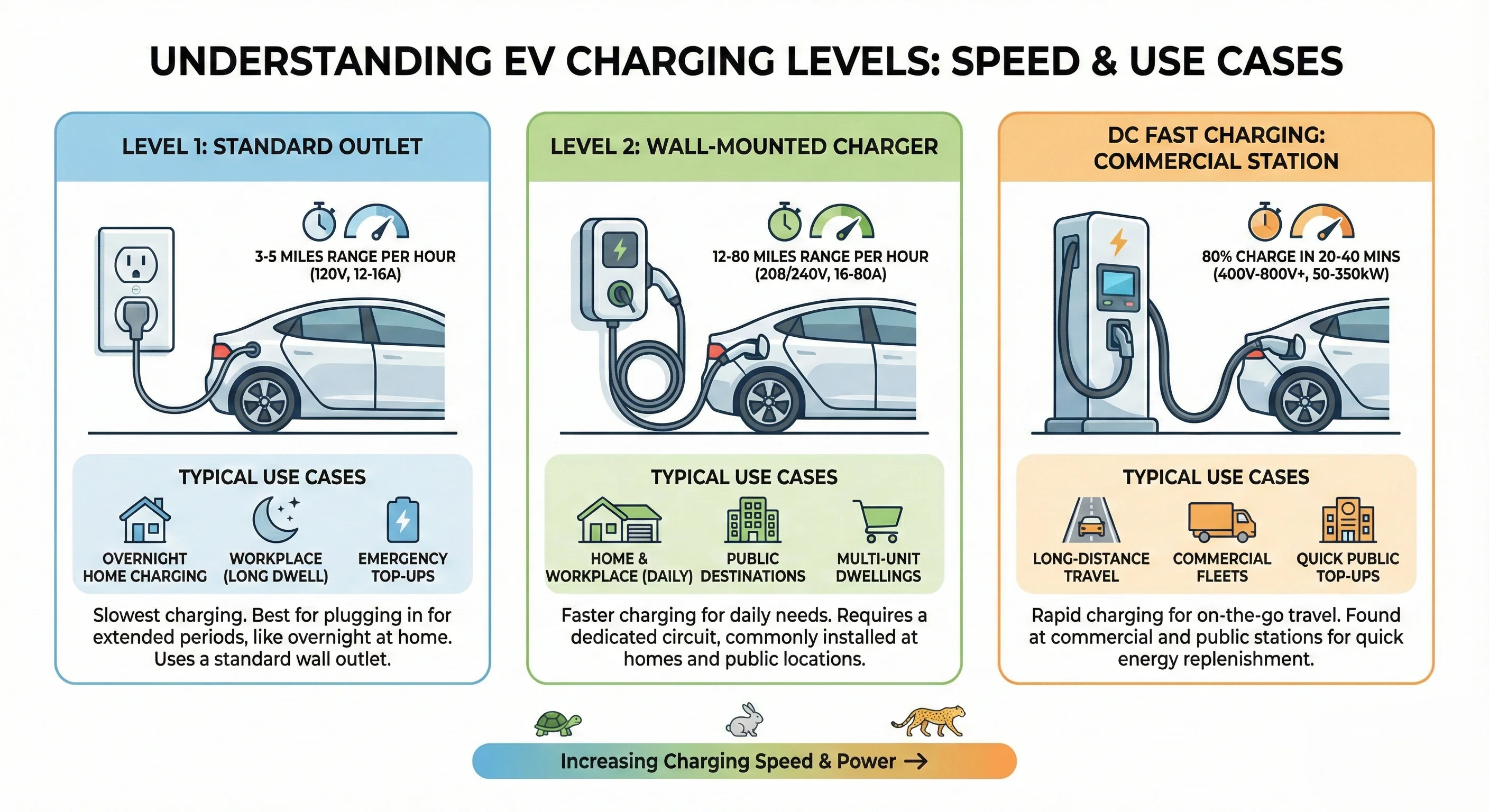
Charging Levels Explained
Level 1 Charging (120V AC)
What is it?: Charging from a standard household outlet (120V in North America).
Specifications:
- Power: 1.4-1.9 kW
- Speed: 3-5 miles of range per hour
- Full charge: 40-50+ hours
Best For:
- Overnight charging for low daily mileage
- Emergency backup charging
- PHEVs with small batteries
- No installation required
Karikimi i Nivelit 2 (240V AC)
What is it?: Karikimi nga një prizë 240V (si një prizë tharëseje) ose karikues i dedikuar EV.
Specifications:
- Fuqia: 3.3-19.2 kW (zakonisht 7.2-11 kW)
- Shpejtësia: 20-40 milje rreze në orë
- Karikim i plotë: 4-8 orë
Best For:
- Karikimi i përditshëm në shtëpi
- Karikimi në vendin e punës
- Karikimi publik gjatë natës ose ditës së gjatë
- Shumica e pronarëve të EV instalojnë këtë në shtëpi
Note: This is the sweet spot for most EV owners. Fast enough for daily needs, gentle on the battery, and affordable to install.
DC Fast Charging (DCFC)
What is it?: High-power DC charging that bypasses the car's onboard charger.
Specifications:
- Power: 50-350 kW
- Speed: 100-200+ miles in 15-30 minutes
- 80% charge: 20-40 minutes
Best For:
- Road trips and long-distance travel
- Quick top-ups when needed
- Commercial/fleet vehicles
- When you can't charge at home
Important: Charging slows significantly after 80% to protect battery health. For fastest charging, plan to charge from 10-80%.

Lidhësit
Amerika e Veriut
J1772 (Tipi 1)
Use: Level 1 and Level 2 AC charging
Compatibility: All non-Tesla EVs in North America
Power: Up to 19.2 kW (typically 7.2 kW)
CCS1 (Sistemi i Kombinuar i Karikimit)
Use: DC fast charging
Compatibility: Most non-Tesla EVs in North America
Power: 50-350 kW
Note: Combines J1772 with DC pins for one universal port
NACS (Tesla)
Use: All charging levels (AC and DC)
Compatibility: Tesla vehicles and most new EVs sold in North America
Power: Up to 250 kW (Supercharger V3)
Note: Now the official US standard (SAE J3400). Adopted by Ford, GM, and most major automakers.
CHAdeMO
Use: DC fast charging
Compatibility: Nissan Leaf, older Japanese EVs
Power: Up to 62.5 kW (some stations up to 100 kW)
Note: Being phased out in favor of CCS
Evropë
Tipi 2 (Mennekes)
Use: Level 2 AC charging
Compatibility: All EVs in Europe
Power: Up to 43 kW (typically 7-22 kW)
Note: European standard for AC charging
CCS2
Use: DC fast charging
Compatibility: All modern EVs in Europe
Power: 50-350 kW
Note: Combines Type 2 with DC pins, European standard
Faktorët e Shpejtësisë
Limiti i Automjetit
- • Makina juaj ka një normë maksimale karikimi (p.sh., 150 kW).
- • Ajo nuk mund të karikohet më shpejt se kjo, pavarësisht nga stacioni.
- • Battery temperature (cold = slower)
- • State of charge (slows after 80%)
Charger Limitations
- • Charger power output (kW rating)
- • Shared circuits (power split between cars)
- • Grid capacity at location
- • Charger condition and maintenance
Key Point: Your charging speed is limited by whichever is lower - your vehicle's maximum charging rate or the charger's output. A 350 kW charger won't charge a vehicle with a 50 kW max rate any faster than a 50 kW charger would.
Shpjegimi i Kurbës së Karikimit
Mendoni për mbushjen e një gote me ujë. Ju derdhni shpejt në fillim, por ngadalësoni ndërsa arrini në krye për të mos e derdhur.
Pro Tip: For fastest road trip charging, plan to charge from 10-20% up to 80%. The last 20% takes almost as long as the first 80%, so it's more efficient to stop more frequently and charge to 80% rather than waiting for 100%.
Quick Reference
Daily Charging: Level 2 at home (7-11 kW) - plug in overnight
Road Trips: DC Fast Charging (50-350 kW) - 20-30 minute stops
Emergency: Level 1 from any outlet - slow but works anywhere
North America: J1772 (AC) + CCS1 or NACS (DC)
Europe: Type 2 (AC) + CCS2 (DC)